A LiteFarm Experience: A Pan African Co-Design Workshop on Community-Owned Digital Futures
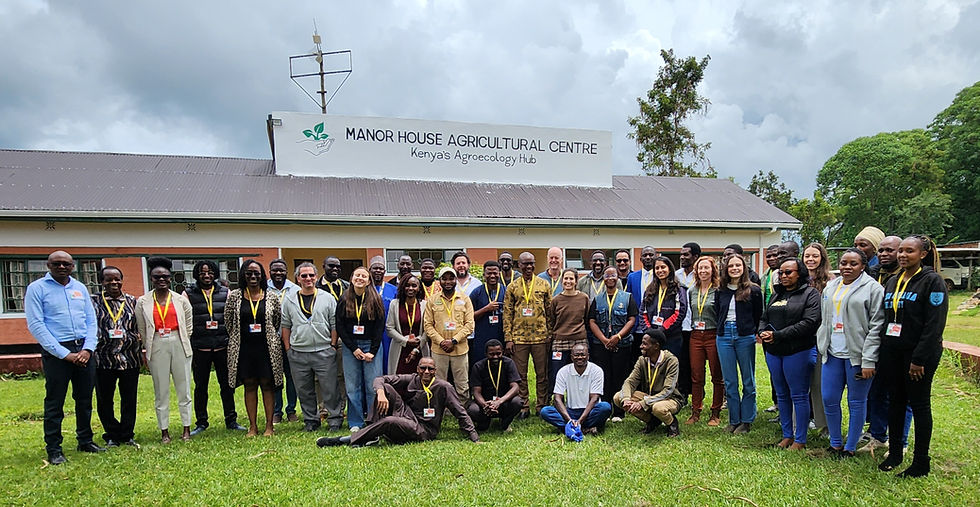
Divya Chayanam and Carolina Diaz represented the UBC LiteFarm team in Kitale, Kenya, in May 2026, for an exciting workshop organized by IDEMS International discussing agroecological systems, and the role of digital tools in smallholder farming contexts.
The conference brought together researchers, practitioners, NGOs, technologists, and farmer-focused organizations working across agroecology, digital agriculture, and data governance in Africa and other global contexts. While highly technical in parts, the dominant underlying theme was not technology itself, but who controls agricultural knowledge, how it is produced, and how it is used. Here are some reflections and lessons that come from the conference.
1. Strong convergence around data sovereignty and ownership
A consistent theme throughout the workshop was the question of data governance in agriculture systems:
Who owns farm-level and agricultural data?
Where is it stored and who can access it?
How is it used in research, policy, or commercial systems?
How can communities retain control over their own knowledge systems?
Multiple initiatives (e.g. farmer cooperatives, research platforms, and digital agriculture tools) are actively experimenting with community-owned or locally governed data infrastructures.
Just like in Canada, the conversations about tech are shifting from “data collection” toward data ethics, access, and power distribution. Should the priority be protecting data through strict governance frameworks, or maximizing usefulness by working with already available datasets? Is there a way to achieve both of these objectives simultaneously?
2. Infrastructure constraints shape product reality
Across tools presented (farm operation management systems, AI tools, weather integrations, mapping platforms), recurring practical constraints included:
Inconsistent internet connectivity (mostly because of data costs, not signal quality)
Device limitations (smartphones and computers are costly)
Challenges with GPS-based mapping precision (Global-South regions satellite mapping is not prioritized/updated as much as Global North regions; challenges with tree shadows in tropical areas).
Need for offline or low-bandwidth functionality
There is a gap to keep in mind: what agricultural software builders in high resource environments assume is possible vs. what field conditions actually allow.
3. Strong experimentation ecosystem for digital agriculture tools
The workshop showed a wide ecosystem of tools and approaches already being tested, including:
Farm management and learning platforms: Jokko FarmOS (SYNAVAL); AE App (Manor House), CEF-M app, LiteFarm
Farmer chat-based advisory systems and extension tools: Farmer Chat (Digital Green); NextGen- Agroadvisory ; SIMAGRI (extension services)
Weather station integrations: Frugal IoT (Natural Innovation); E-PICSA;
AI and speech tools for local languages: IA Mali Oral AI
Community data hubs and markets: FUMA Gaskiya; KPL Food Coop Market; BIBA
Biodiversity and soil monitoring tools: Terraso and LandPKS (TechMatters); Datar App Platform for Agrobiodiversity Research
Research methodology and support tools: CIAT-ASIS Databases and Maps, Stats4SD
There is not a lack of innovation in African agricultural tech contexts: there is an ecosystem of parallel experimentation happening across research and practitioner groups, especially in agroecology.
4. Research practice was actively questioned and redefined
An interesting discussion focused not on tools, but on how research itself is conducted:
Discussion: What makes a good community researcher?
Clarity on research goals and funding intentions openly expressed
Communicating how research outputs will be used and how they will change lives for the communities
Evaluate goals: extractive research practices vs. participatory models
Recognize tension between academic publication incentives and community relevance
There was also optimism expressed around:
Agroecology research programs that already embed community collaboration
Journals and publication models that prioritize applied sustainability work, even with simple methods
Emerging efforts to reorient research toward real-world impact rather than academic output alone

5. Strong emphasis on inclusivity, affordability and representation of local knowledge
Across multiple presentations (soil systems, biodiversity tools, climate models, farm management systems), we were reminded that agroecology work is highly technical and research-intensive, but it is also highly localized, gendered, and socially embedded:
Women's and men's experiences and knowledge in agriculture are different, and this must be explicitly recognized. Women’s agricultural knowledge is often underrepresented and can be even disregarded as unimportant. In truth women’s knowledge can be equal, if not more proficient than men, for example in seed sovereignty and stewardship, like this research from Niger by Kader Naino shows.
We have much to learn from low-resource environment resourcefulness and hacking. We can leverage social and ecological realities and strategies as advantage!
Technology (research, tool, app building) must integrate with local systems of knowledge (farmer-sharing assemblies, solidary economies, traditional women’s seed saving). Local and indigenous knowledge systems should be central to the work performed, not peripheral
There are trade-offs between “village-level” initiatives vs regional level projects. Large coordination, especially at government level funding, compromises localized impacts, and the trade-off can be better acknowledged.
Key insight for LiteFarm: Agricultural data is not neutral or universal—it is shaped by local ecotypes, gender roles, land use systems, and social organization: ability to customize is super important, but we also need to consider ways to harmonize the diversity through shared ontologies and translation frameworks.
6. Broader Patterns
Through the conference, we observed that there is a strong ecosystem of highly educated researchers, practitioners, and technologists across Africa working at a global level of sophistication in agroecology and digital systems. This challenges mainstream narratives and prejudices that often portray African agricultural contexts as “behind” or “lacking expertise”. Like anywhere else in the world, there is a highly specialized technical and research community, and a broader population working within different levels of access to education, resources, and infrastructure. The difference is resource distribution at a national level, institutional reputation context and international narrative bias. Most news coming out of Africa focus on war, epidemics and catastrophe, but news about excellent work don’t make the headlines!
As tech creators and endorsers, we are biased to believe that tech and data can improve a farmer’s life. But this isn’t necessarily true. Farmers have been historically approached by private companies and coerced for data collection in a power asymmetry that has led to abuse. Therefore, trust is extremely important in implementing successful digital solutions. For good and consistent data collection, it is better to have local representation as the voice of trust, no matter how good an application or data policy an app has.
Tech is never supposed to eliminate human connection in agriculture, but support it. Many people had a strong opinion on this: They are comfortable with data telling a story, but they would still like to hear from another farmer. This means that tech is not expected to, or even supposed to, replace cooperative or community structures.
We are excited about how communities are building technology, even if they might have reservations about them. We are hopeful and inspired when to be working amongst folks striving to benefit their communities. We are also impressed by the knowledge of agroecological methods, conservation, and biodiversity efforts happening! Amazing things are happening in Africa!
To sum it up, across all five days, 3 overarching lessons stand out:
Agricultural data is political, not just technical (ownership, governance, access).
Context realities, gender roles, and traditional knowledge must be central to building quality solutions (hardware and data access, women’s knowledge reappraisal, traditional community structures).
There is a mature ecosystem of agricultural technological innovation - coordinating, aligning and working with existing stakeholders must be a priority.
Until next time,
Divya and Lina


Comments